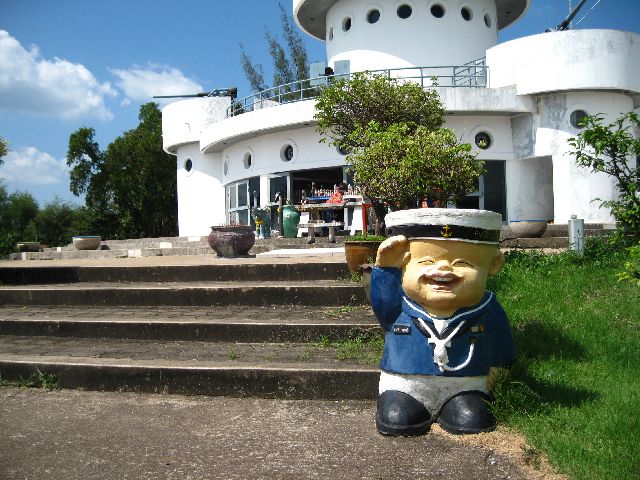
The Battle of Koh Chang 1941
I was emailed by a Thai historian, Khun Songklod. There are several discrepancies between the Thai & French versions of the battle:
The Thai and French points of view are clearly contradictory about what happened during the first encounter, south of the island. According to the above article, there were two torpedo-boats present and both were destroyed. The Sri Ayudhaya was neither sunk nor even present. The French version speaks of three torpedo boats and one coastal battleship. The first torpedo attack of the Lamotte-Picquet would have hit the Sri Ayudhaya, while the Thai claims that it missed.
Without pretending to decide between the two points of view, the editor allows himself to mention two facts favoring the Thai thesis:
1. The encounter happened in early hours, middle in a winter day with a little fog and rain. The Thai ships were confused with the land background. Since the French did not go nearer than several thousands meters, an error of observation is more probable on their side than on the Thai side.
2. The French are contradicting themselves when they claim to have performed a clean sweep among the Thai ships in the south of the island, while they recognize that the Sri Ayudhaya had only run aground and that one of the torpedo boat survived the battle.
Despite the fall of France in 1940 the Vichy government still held sway over France’s colonial territories abroad. One of these territories was French Indo-China, what we know today as Vietnam and Kampuchea (Cambodia). With the defeat of mainland France obvious doubt was thrown over her ability to defend the far flung outposts of the empire. French Indo-China held a particular attraction to her neighbour to the West, Thailand.
In late 1940 the Thais began a series of cross border attacks by troops and aircraft against the French possessions, aimed at annexing those parts of French Indo China which the French were unable to hold on to. These attacks tended to concentrate in the coastal regions of Cambodia, to the west of Saigon. The Thais naturally saw themselves as filling a power vacuum which had been created by deflating French colonial interests.
The French, however, had other ideas and a state of war was assumed between Vichy France and Thailand (then still often referred to as Siam). Since the main thrust of the Thai assaults had been along the coast the French considered a naval operation against the invaders, although there was grave concern over strengths of the Thai armed forces which would oppose such a mission.
The Royal Thai Navy could in no way be regarded as a pushover. A number of new vessels had recently been delivered from Japan and Italy. The major units of the fleet are listed in Table 1, and included two Japanese-built armoured coast defence vessels which displaced 2,500 tons and carried 8″ guns, two older British built armoured gunboats with 6″ guns, twelve torpedo boats and four submarines.
In addition the Royal Thai Air Force had in its inventory over 140 aircraft, including relatively modem Mitsubishi Ki-30 light bombers, which saw extensive service against the French. These aircraft in themselves were quite capable of causing severe damage to any French naval mission which may be mounted. Other less capable aircraft in the Thai inventory included 25 Curtiss Hawk 75N, 70 Vought Corsair biplanes, 9 B-10 bombers and several Avro 504 trainers.
Despite the strengths of the Thai forces the French Governor General of Indo-China and Commander-in-Chief Naval Forces, Admiral Jean Decoux, decided that the naval mission should go ahead. A small squadron, the Groupe Occasionnel, was formed on 9th December 1940 at Cam Ranh Bay, near Saigon, under the command of Captain de Vaisseau Berenger.
The squadron consisted of the light cruiser Lamotte-Picquet, the colonial sloops Dumont d’Urville and Amiral Charner, and the older sloops Tahure and Marne. There was no air cover to speak of, apart from eight Loire 130 seaplanes based at Ream which provided reconnaissance. Additional scouting was provided by three coastal survey craft, and intelligence gleaned from the local fishermen.
Berenger’s squadron began training manoeuvres in Cam Ranh Bay shortly after coming together. Early in the new year, on January 13th 1941, Admiral Decoux formally requested Berenger to send the squadron against the Thais to act in support of a land offensive planned for the 16th. This operation was intended to throw back Thai forces which had been advancing along the coast. Because of the disparate speeds of the French ships Berenger sent the slower sloops on ahead, whilst he remained in Saigon to complete the final elements of the plan.
Several options were currently being prepared, the Admiralty in Paris having recently given its formal blessing to the use of naval forces in support of the army. The final planning meeting of the 13th saw an immediate delay in the execution of the operation for 24 hours. With the plans finalised, Berenger sailed in Lamotte-Picquet, the delay in the start of the operation allowing him to refuel at Cap St. Jacques before the rendezvous with the slower ships at 16:00 on the 15th, 20 miles North of Poulo Condore.
The orders from Admiral Decoux were clear and simple, “Seek out and destroy the Siamese naval forces from Satahib to the Cambodian frontier”. On the evening of the 15th, following a final conference on board the flagship, the squadron weighed anchor at 21 15 and closed the Thai coast at 14 knots, the best speed of the sloops.
The French ships remained undetected as they entered the Gulf of Siam, but their quarry was not so lucky. The Loire 130s from Ream had completed a sweep of the coast from Trat to Satahib. They had located one coast defence ship and three torpedo boats at Koh Chang, and one gunboat, four torpedo boats and two submarines at Satahib.
Their report was sent to Marine Headquarters in Saigon, who retransmitted the report to the Lamotte-Picquet. Berenger considered his options in the light of this intelligence and opted for a dawn attack on Koh Chang. He discounted an attack on Satahib because it was not possible for the sloops to reach the port until later in the day, by which time the Thai force was likely to have been alerted to the French presence and the element of surprise would be lost. In addition there was doubt as to the contribution which the harbour defences at Satahib could make. Finally the force at Koh Chang, although formidable, was the weaker of the two and was thought to offer the best chance for victory.
Berenger’s plan of attack was as follows. The squadron would approach at dawn from the South West. Because the anchorage at Koh Chang was surrounded by islands and islets, many of which were over 200 metres high, the squadron would break up and use the cover of the islands to concentrate fire on portions of the Thai squadron whilst covering all the avenues of escape.
The easternmost channel was regarded as the most likely route by which a breakout would be made – this was the most suitable route and was also the area in which the recce report had placed the largest Thai ships. The Lamotte-Picquet would head to the eastern side of the anchorage to block this route whilst the colonial sloops blocked the centre and pounded the Thai ships there. The smaller French ships would concentrate to the West.

The Attack
The French squadron closed on the anchorage at 05:30 on the 17th. At 05:45 they split into the three groups as planned, the Lamotte-Picquet heading for the Eastern part of the anchorage, Dumont d’Urville and Amiral Charner continuing to the central position and the Tahure and Marne heading for the Western side. Conditions were perfect – the weather was fine, the seas calm and almost flat. Sunrise was due at 06:30, and the scene was lit only by the first rays of light on the horizon and by the dim moonlight.
A final aerial reconnaissance of the target area had been arranged using one of the Ream-based Loire 130s (Lamotte-Picquet carried two such aircraft, but these could not be launched due to catapult problems). At 06:05 the Loire 130 overflew the anchorage and reported two coastal defence ships.
This came as a nasty surprise to the French – previous reports led them to believe that only one of the large defence ships was present, but during the night the Dhonburi had arrived to relieve the Sri Ayuthia, which was to return to Satahib later that day. Once their presence had been passed to the Lamotte-Picquet the aircraft attempted an attack of its own using bombs, but was forced off by a heavy barrage of AA fire.
The effect of this mission was double edged – the French were now aware that they faced both the Thai heavy units, but the element of surprise had been wasted and there was still thirty minutes to go until sunrise. Caught napping by the oncoming French the Thais desperately began to raise steam and make preparations for slipping their anchors. The coastal defence ships had an advantage over their smaller consorts since, being diesel powered they were able to get under way almost immediately.
Despite their initial shock at coming under attack it was the Thai forces which opened fire first at 06:14 when the range had come down to 9,000 metres. The French responded almost immediately. Lamotte-Picquet fired at the dark shapes in the anchorage and fired a spread of three torpedoes at 06 20. One torpedo was seen to hit the coastal defence ship Sri Ayuthia. Heavily damaged by the torpedo and gunfire she headed for the cover of the islands and was finally beached on the mainland.
The torpedo boat Trad then became the Lamotte-Picquet’s next target. She was heavily damaged and also disappeared behind the cover of the islands, where she later sank. Fire then switched to the remaining torpedo boats, Chonburi and Songhkli, which were rapidly overwhelmed and abandoned. Gunfire from the sloops finished them off at 07:00.
At 06:38 the lookouts on the Lamotte-Picquet spotted the second coastal defence ship, the Dhonburi, at a range of 10,000 meters heading to the North West. A running battle ensued with the fire of both ships frequently blocked by the towering islets. The fire from the Thai ship was heavy, but inaccurate. By 07:15 fires could be seen on the Dhonburi, which then found herself engaged not only by the cruiser but also by the sloops.
Believing they had a better chance of hurting the smaller French ships the Thais shifted their fire onto the Amiral Charner, which soon found 8″ salvoes falling around her. The Dhonburi shifted fire back to Lamotte-Picquet after a salvo from the French cruiser put her after turret out of action. Soon she reached the safety of shallow water which the French ships could not enter for fear of grounding, but it all came too late for the hapless Thais as the Dhonburi was burning fiercely and listing heavily to starboard. At 07:50 the Lamotte-Picquet fired a final salvo of torpedoes at a range of 15,000 metres but lost sight of the Dhonburi behind an island from which she was not seen to emerge.
For the next hour the French ships patrolled the area, picking up survivors and ensuring their victory was total. At 08:40 Berenger ordered the squadron to head for home, but this coincided with the start of the expected Thai air attacks. Several bombs were dropped close to the Lamotte-Picquet but a vigorous barrage was put up by the ship’s AA guns and further attacks were not pressed home. The final raid departed at 09:40, following which the victorious French squadron returned to Saigon.
The French left behind them a scene of total devastation. The Sri Ayuthia was heavily damaged and hard aground on a sand bar in the mouth of the Chantaboun river. She was later raised and repaired by the Japanese, survived the war, but was sunk by Thai shore batteries on 3rd July 1951 during an attempted revolution. The Thai transport Chang arrived at Koh Chang shortly after the French departed and took the Dhonburi in tow but she eventually capsized that afternoon and was a total loss.
The torpedo boats Trad, Chonburi and Songhkli had all been sunk. The only survivors were the torpedo boat Rayong, the minelayer Nhong Sarhai and the fishery protection vessel Thiew Uthok. These three ships, which had been sheltering to the North of Koh Chang, wisely chose not to break cover and thus were not observed by the French.
At a stroke the cream of the Royal Thai Navy (stand fast the four submarines) had been wiped out. The French were elated, for they had inflicted a defeat as decisive in its way as the Japanese at Tsushima. Their success is all the more notable when the difficulties of navigating and fighting in such confined waters are considered, and given the courage and tenacity which the Thai sailors exhibited during the action (a fact which the French were gracious to accept).
In the end though it was all for nought – five days later the Japanese government offered to ‘arbitrate’ in the search for a peaceful settlement, and soon confirmed the Thai annexations. Even this state of affairs did not last for long, as Thailand was invaded later that year during the attacks on Malaya, and was forced to return her short-lived gains to France at the end of WW2.
Today the island of Koh Chang and its surrounding waters have been designated a Maritime Nature Reserve. Nothing remains visible above the surface to remind the visitor of this remarkable battle.
Commemoration of the Battle of Koh Chang 2020
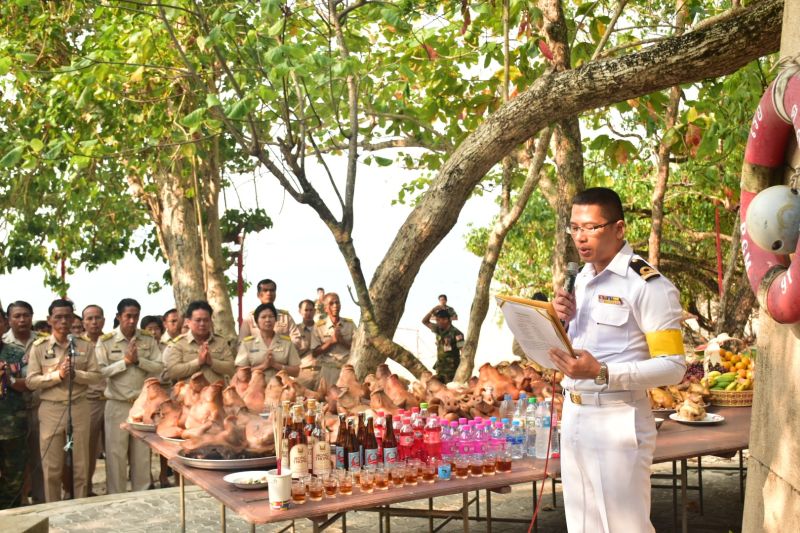
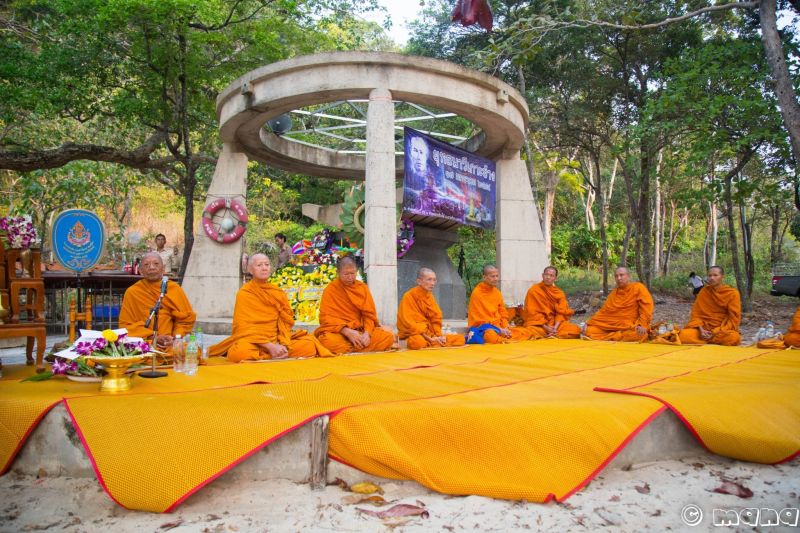
Every year on the anniversary a ceremony is held to remember the Thai sailors who lost their lives during the battle. This is held at the memorial at Hat Yuthanavy beach in the south east of the island, near Long beach. This is the closest point to where one of the Thai ships sank. Wreaths are laid on the buoy which marks the ships location.
These photos are provided by the Koh Chang Administration: https://www.facebook.com/kohchangtai






70th Anniversary Commemoration 2011
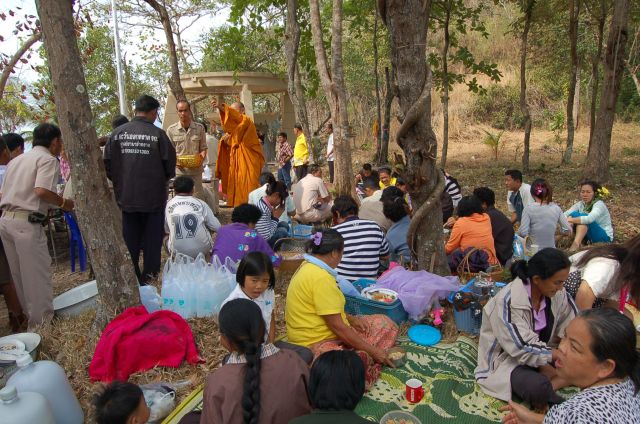
Every year there are ceremonies on the mainland at the memorial near Krom Luang pier, just out of Laem Ngop and also at the smaller memorial at Hat Yuthanavy in the southeast of Koh Chang that commemorate the bravery of the Thai sailors and the 36 who died.
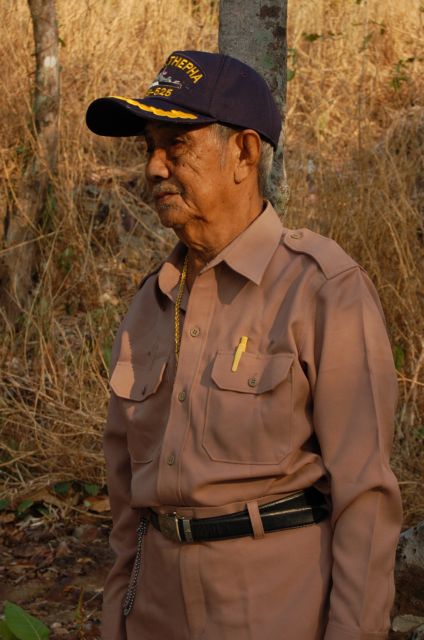
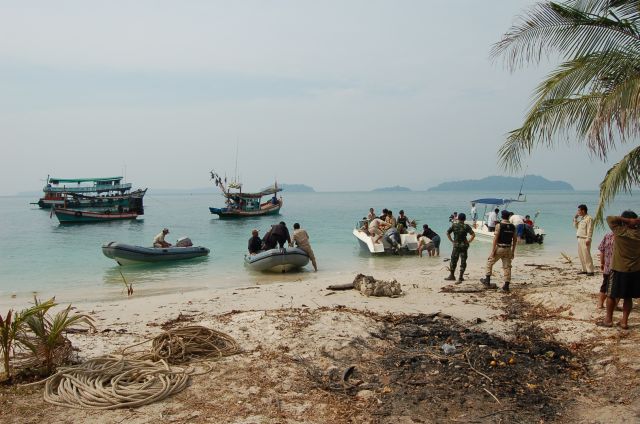
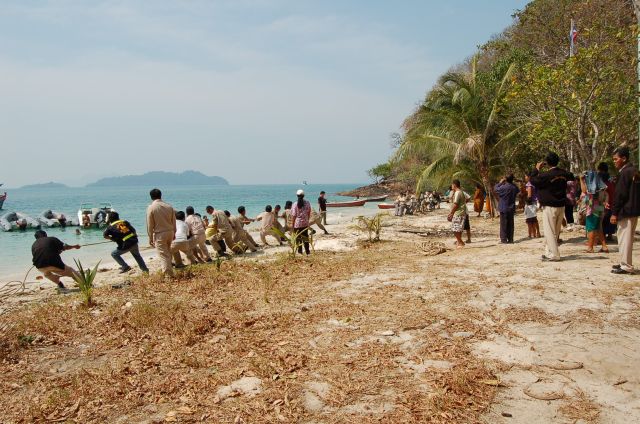
As 2011 was the 70th anniversary of the battle, more people than usual showed up from all over the island. A couple of hundred people showed up, including pupils from Klong Prao school who came by boat from the west coast. Guest of honour this year was the sole living survivor. He was a ship’s cook and was ashore buying supplies when the French attacked. Thailand’s Channel 3 TV were there and you can see him being interviews in the pics.
Locals from the Salakkok and Salakphet area donated money to buy food for the monks and everyone in attendance. For some reason, the people organisng the event thought the best way to achieve this was to buy 40 pigs heads with the funds that were raised.
The land where the memorial is located is currently under dispute as someone has suddenly discovered they have a title deed for the land. See if you can spot the person in the photos below that none of the attendees knew and thought was a spy, sent on behalf of the person claiming the land, to watch proceedings.
Photos:





Battle of Koh Chang Naval Memorial in Laem Ngop
This memorial was built to commemorate the Battle of Koh Chang, a naval encounter between the Thai and French navies in January 1941. You will find the memorial here:
Photos: